

Judge Loretta Preska has approved a joint motion filed by the Teamsters and the Justice Department to lift federal oversight of our union. What does this mean for the future of anti-corruption efforts and International Union elections?
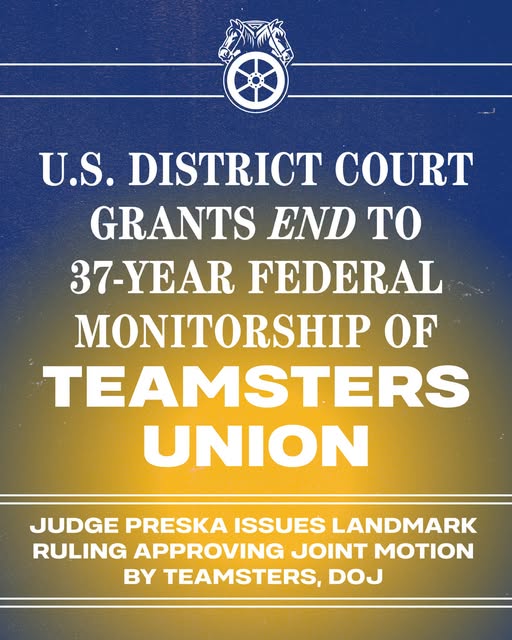
A federal court has had oversight over the Teamsters since the Justice Department settled a lawsuit in 1989 with the Teamsters agreeing to a system of one-member, one-vote elections for International Union officers and an independent system for monitoring corruption in the Teamsters Union.
Now, 37 years after the original court order, the longest federal monitorship of any union, corporation or public institution is coming to a close.
What will the change mean to Teamster elections?
Teamsters will continue to elect our International Union officers in one-member, one-vote elections.
These elections will continue to be supervised by an independent Election Supervisor. This system is permanently enshrined in the Revised Final Order and in the Teamsters constitution.
The Teamsters constitution requires candidates for International Union office to be nominated by 5% of the delegates to the IBT Convention. The 5% nomination threshold is guaranteed through the 2031 election.
The motion approved by Judge Preska allows the nomination threshold to be raised up to a maximum of 8% by a vote of the Convention delegates to amend the Teamsters Constitution.
The 8% cap is a new and permanent ceiling on any future nomination threshold. Before this new court-approved order, the nomination threshold could have been raised without limit.
Will the rules for nominating candidates for International office change?
Hypothetically, a change could be made as soon as the 2031 IBT Convention to establish a new threshold for the 2036 election.
The 5% threshold has repeatedly proven to be the right number for nominating candidates for International Union office. It has worked well for 35 years.
If a higher standard had been in place in previous Teamster elections then candidates who got as high as 49% to 57% of the vote of the members would have been blocked from getting on the ballot.
What will the change mean for monitoring corruption?
Going forward, the IBT will be responsible for internal discipline and audits. The order requires the IBT to maintain and fund an Office of Compliance Standards and Investigations (OCSI).
Former federal judge, Barbara S. Jones (retired), will continue to serve in her position as Independent Review Officer and to monitor the IBT’s investigations and audit departments to ensure complaints, investigations and audits for three years.
Jones will have an option to extend that term if she believes the IBT is not sufficiently maintaining its disciplinary and audit systems.
The IBT will permanently maintain an outside Independent Director to oversee the disciplinary and audit systems even after Jones’ term as independent review officer ends.
Why is this happening now?
The original consent order was established in 1989 when the IBT settled a Racketeer Influenced Corrupt Organization (RICO) lawsuit filed after years of corruption and mob influence.
Three Teamster General Presidents went to jail and a fourth, Jackie Presser, died of a heart attack before his trial on federal racketeering and embezzlement charges could go to trial in 1988.
That was almost 40 years ago. Today’s Teamsters Union is very different. Organized crime influence targeted by the 1987 RICO lawsuit has been eliminated.
The Independent Investigations Officer (IIO) has issued only three sets of charges in the last two years. One involved a local union officer who drove a union vehicle for a decade without a valid license because of a DUI conviction.
The most serious charge was against former IBT vice president Chris Griswold and Sean Harren for charging lavish meals and drinks to the union.
General President Sean O’Brien and General Secretary Treasurer Fred Zuckerman pressed them to resign after an IBT audit uncovered the misspending.
The IBT argued that this low level of output did not justify the expense of the IIO whose operation costs an estimated $4.5 million per year in dues and that the IBT can police itself.
Where does TDU stand?
During the original RICO lawsuit in 1987, the Justice Department tried to put the Teamsters under a government trusteeship.
TDU opposed government control of our union and launched a campaign under the slogan: "No mob control, no government control, give Teamsters the Right to Vote."
We won the right to elect International Union officers in one-member, one-vote elections as part of the RICO case settlement in 1989.
For 37 years, TDU has fought for fair election rules enforced by an independent election officer. We have opposed efforts to weaken members’ election rights, including raising the nomination threshold.
To protect and improve our Right to Vote, TDU has gone to court multiple times, successfully added new protections to the Rules, met with every Election Supervisor, and filed hundreds of election protests.
Member involvement and direct elections are how the rank and file should choose our leaders and hold them accountable.
The foundation of our union's power is member involvement. Corruption breeds cynicism, alienates members, and weakens our union.
That’s why TDU has opposed and exposed corruption and wrongdoing for 50 years and we will continue to do so.
There have been different corruption mechanisms, from the independent review board to the independent disciplinary officer. We have never taken a position on what tool should be used.
Running a clean union is what counts. That job is up to all of us. TDU will do our part.